Showing posts with label electronic seminar topics. Show all posts

Sunday, September 23, 2012

Energy-efficient communication protocol for wireless microsensor networks

Wireless distributed microsensor systems will enable the reliable monitoring of a variety of environments for both civil and military applications. In this paper, we look at communication protocols, which can have significant impact on the overall energy dissipation of these networks. Based on our findings that the conventional protocols of direct transmission, minimum-transmission-energy, multihop routing, and static clustering may not be optimal for sensor networks, we propose LEACH (Low-Energy Adaptive Clustering Hierarchy), a clustering-based protocol that utilizes randomized rotation of local cluster base stations (cluster-heads) to evenly distribute the energy load among the sensors in the network. LEACH uses localized coordination to enable scalability and robustness for dynamic networks, and incorporates data fusion into the routing protocol to reduce the amount of information that must be transmitted to the base station. Simulations show that LEACH can achieve as much as a factor of 8 reduction in energy dissipation compared with conventional routing protocols. In addition, LEACH is able to distribute energy dissipation evenly throughout the sensors, doubling the useful system lifetime for the networks we simulated.

Download

Project Absract- Resilient Overlay Networks

A Resilient Overlay Network (RON) is an architecture that allows distributed Internet applications to detect and recover from path outages and periods of degraded performance within several seconds, improving over today’s wide-area routing protocols that take at least several minutes to recover. A RON is an application-layer overlay on top of the existing Internet routing substrate. The RON nodes monitor the functioning and quality of the Internet paths among themselves, and use this information to decide whether to route packets directly over the Internet or by way of other RON nodes, optimizing application-specific routing metrics. Results from two sets of measurements of a working RON deployed at sites scattered across the Internet demonstrate the benefits of our architecture. For instance, over a 64-hour sampling period in March 2001 across a twelve-node RON, there were 32 significant outages, each lasting over thirty minutes, over the 132 measured paths. RON’s routing mechanism was able to detect, recover, and route around all of them, in less than twenty seconds on average, showing that its methods for fault detection and recovery work well at discovering alternate paths in the Internet. Furthermore, RON was able to improve the loss rate, latency, or throughput perceived by data transfers; for example, about 5 % of the transfers doubled their TCP throughput and 5 % of our transfers saw their loss probability reduced by 0.05. We found that forwarding packets via at most one intermediate RON node is sufficient to overcome faults and improve performance in most cases. These improvements, particularly in the area of fault detection and recovery, demonstrate the benefits of moving some of the control over routing into the hands of end-systems.

Download

Project abstract - Survey of Image Registration Techniques

Registration is a fundamental task in image processing used to match two or more pictures taken, for example, at different times, from different sensors or from different viewpoints. Over the years, a broad range of techniques have been developed for the various types of data and problems. These techniques have been independently studied for several different applications resulting in a large body of research. This paper organizes this material by establishing the relationship between the distortions in the image and the type of registration techniques which are most suitable. Two major types of distortions are distinguished. The first type are those which are the source of misregistration, i.e., they are the cause of the misalignment between the two images. Distortions which are the source of misregistration determine the transformation class which will optimally align the two images. The transformation class in turn influences the general technique that should be taken.


Download

Download link2

Myrinet: A Gigabit-per-Second Local Area Network

Myrinet is a new type of local-area network (LAN) based on the technology used for packet communication and switching within "massivelyparallel processors " (MPPs). Think of Myrinet as an MPP message-passing network that can span campus dimensions, rather than as a wide-area telecommunications network that is operating in close quarters. The technical steps toward making Myrinet a reality included the development of (1) robust, 25m communication channels with flow control, packet framing, and error control; (2) self-initializing, low-latency, cut-through switches; (3) host interfaces that can map the network, select routes, and translate from network addresses to routes, as well as handle packet traffic; and (4) streamlined host software that allows direct communication between user processes and the network. Background. In order to understand how Myrinet differs from conventional LANs such as Ethernet and FDDI, it is helpful to start with Myrinet's genealogy. Myrinet is rooted in the results of two ARPA-sponsored research projects, the Caltech Mosaic, an experimental, fine-grain multicomputer [1], and the USC Information Sciences Institute (USC/ISI) ATOMIC LAN [2, 3], which was built using Mosaic components. Myricom, Inc., is a startup company founded by members of these two research projects. Multicomputer Message-Passing Networks. A multicomputer [4, 5] is an MPP architecture consisting of a collection of computing nodes, each with its own memory, connected by a message-passing network. The Caltech Mosaic was an experiment to "push the envelope " of multicomputer design and programming toward a system with up to tens of thousands of small, single-chip nodes rather than hundreds of circuit-board-size nodes. The fine-grain multicomputer places more extreme demands on the messagepassing network due to the larger number of nodes and a greater interdependence between the computing processes on different nodes. The message-passing-network technology developed for the Mosaic [6] achieved its goals so well that it was used in several other MPP systems

Download

Monday, August 15, 2011

122 Seminar & projects

Here are 122 seminar topics related to computer science, electronics and  electrical field along with power point presentation.

    1. Project Abstract - E-Learning
    2. Seminar on SMTP
    3. Seminar on Software as a service
    4. Project - Time Attendance
    5. Tabu Search Algorithm For Cluster Building In Wire...
    6. Seminar on Online identity management
    7. Seminar on Website Marketing
    8. Seminar on Personality development
    9. How to make a Presentation
    10. Seminar on Project management
    11. Seminar on leadership qualities
    12. Seminar on Linux Virtual File System
    13. Internet Marketing Strategy
    14. Seminar on Internet Marketing
    15. Seminar on Affiliate marketing
    16. Seminar on Search Engine Marketing
    17. Seminar on Time management
    18. Seminar on Java Security
    19. Web Services in Java
    20. Seminar on SDLC
    21. Seminar on fingerprint recognition
    22. Project Abstract - Hospital Management System
    23. Seminar on Android
    24. Seminar on Organizational information systems
    25. Project - Digital library
    26. Seminar on E-Business
    27. Seminar on Iris Scanning
    28. Grid network
    29. Earth Simulator
    30. M-Commerce
    31. Socket Programming
    32. video door phone
    33. CCTV System
    34. WI-MAX
    35. WISENET
    36. Optical fiber communication
    37. Lightweight Directory Access Protocol
    38. Kerberos
    39. Organic light emitting diode (OLED)
    40. Augmented Reality
    41. The Bionic Eye
    42. Optical Communications in Space
    43. 4G Wireless Systems
    44. Bittorrent
    45. Wireless USB
    46. Tripwire
    47. Data mining
    48. Interactive Voice Response
    49. Nessus
    50. Mobile Computing
    51. Holographic Versatile Disc
    52. Satellite radio
    53. Silverlight
    54. Bluetooth
    55. Wearable computers
    56. Cluster computing
    57. Quantum computer
    58. HVAC
    59. Mobile IP
    60. FireWire
    61. Home Networking
    62. Plasma display
    63. PLAN 9 Operating system
    64. Global Positioning System
    65. Spyware and Trojan horses
    66. Voice over Internet Protocol
    67. SSL-TLS
    68. PolyBot - Modular, self-reconfigurable robots
    69. Facial recognition system
    70. Captchas
    71. Ext3 File System
    72. Embedded Linux
    73. Computer forensics
    74. Security Protocol For Sensor Network
    75. Signal processing
    76. Seminar on Smoke detector
    77. Seminar on Motion detector
    78. Seminar on Transformer
    79. Seminar Test automation framework
    80. Seminar on Digital and analog signals
    81. Seminar on Programmable logic controller
    82. Seminar on LED
    83. Seminar on power systems automations
    84. Seminar on Flight Simulator
    85. Application Server
    86. Inventory Control System
    87. Seminar - Online Gaming
    88. Project – Online Survey System
    89. Project Abstract - Traffic Management System
    90. Seminar on IPTV
    91. Seminar on Smartphone
    92. Seminar on Real-Time Operating Systems
    93. Seminar on Agile Methodology
    94. Project on GPS Integrity Monitoring
    95. Seminar on Listening Skills
    96. Seminar on Communication Skills
    97. Seminar on Mobile commerce
    98. Project - Payroll Management System
    99. Seminar on SAP CRM
    100. Seminar on Sales Tracking
    101. Seminar on Marketing
    102. Seminar on Sap R/3 Architecture
    103. Seminar on Software Project Management
    104. Seminar on Motivation
    105. Seminar on CRM
    106. Enterprise resource planning
    107. Seminar on Cloud computing
    108. Project - 2D Sonar
    109. Project - 3D Pong
    110. Project on Laser Pointer Mouse
    111. Project on Fingerprint Verification System
    112. Project - Wireless Surveillance System
    113. Project - Instant messaging
    114. Seminar on Laser Communications
    115. Project - Online Examination System
    116. Nanotechnology
    117. Project on Library Management System
    118. Seminar on web application security
    119. .Net Framework Security
    120. Seminar on .NET framework
    121. Seminar on Artificial intelligence
    122. Seminar on Unlicenced Mobile Access

Incase, you have any suggestion or wants me to add any topic. Kindly post in the comment section.

Thanks!

Signal processing

Signal processing is an area of electrical engineering and applied mathematics that deals with operations on or analysis of signals, in either discrete or continuous time, to perform useful operations on those signals. Signals of interest can include sound, images, time-varying measurement values and sensor data, for example biological data such as electrocardiograms, control system signals, telecommunication transmission signals such as radio signals, and many others. Signals are analog or digital electrical representations of time-varying or spatial-varying physical quantities. In the context of signal processing, arbitrary binary data streams and on-off signaling are not considered as signals, but only analog and digital signals that are representations of analog physical quantities.

Analog signal processing is for signals that have not been digitized, as in classical radio, telephone, radar, and television systems. This involves linear electronic circuits such as passive filters, active filters, additive mixers, integrators and delay lines. It also involves non-linear circuits such as compandors, multiplicators (frequency mixers and voltage-controlled amplifiers), voltage-controlled filters, voltage-controlled oscillators and phase-locked loops.

Presentation

Digital Signal Processing - The University of Texas at Austin
Digital Signal Processing (DSP) Fundamentals
Multirate Digital Signal Processing
Basics of Signal Processing – Intel
Digital Signal Processing Using MATLAB甐.4

Saturday, August 13, 2011

Seminar on Smoke detector

A smoke detector is a device that detects smoke, typically as an indicator of fire. Commercial, industrial, and mass residential devices issue a signal to a fire alarm system, while household detectors, known as smoke alarms, generally issue a local audible and/or visual alarm from the detector itself.
Smoke detectors are typically housed in a disk-shaped plastic enclosure about 150 millimetres (6 in) in diameter and 25 millimetres (1 in) thick, but the shape can vary by manufacturer or product line. Most smoke detectors work either by optical detection (photoelectric) or by physical process (ionization), while others use both detection methods to increase sensitivity to smoke. Sensitive alarms can be used to detect, and thus deter, smoking in areas where it is banned such as toilets and schools. Smoke detectors in large commercial, industrial, and residential buildings are usually powered by a central fire alarm system, which is powered by the building power with a battery backup. However, in many single family detached and smaller multiple family housings, a smoke alarm is often powered only by a single disposable battery.


The first automatic electric fire alarm was invented in 1890 by Francis Robbins Upton (U.S. patent no. 436,961). Upton was an associate of Thomas Edison, but there is no evidence that Edison contributed to this project.
George Andrew Darby patents the first electrical Heat detector and Smoke detector in 1902 in Birmingham, England. [1]
In the late 1930s the Swiss physicist Walter Jaeger tried to invent a sensor for poison gas. He expected that gas entering the sensor would bind to ionized air molecules and thereby alter an electric current in a circuit in the instrument. His device failed: small concentrations of gas had no effect on the sensor's conductivity. Frustrated, Jaeger lit a cigarette—and was soon surprised to notice that a meter on the instrument had registered a drop in current. Smoke particles had apparently done what poison gas could not. Jaeger's experiment was one of the advances that paved the way for the modern smoke detector.

Presentation on smoke detector

Residential Smoke Alarm Installation
Smoke Detectors
How Does A Smoke Detector Work?
First Thought When Smoke Detector Went Off
Smoke Detector Installation.ppt
Wireless Smoke Detection
Carbon Monoxide Detectors & Fire Alarms

Seminar on Motion detector

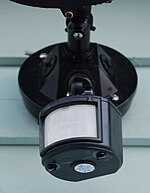
An electronic motion detector contains a motion sensor that transforms the detection of motion into an electric signal. This can be achieved by measuring optical or acoustical changes in the field of view. Most motion detectors can detect up to 15–25 meters (50–80 feet).
A motion detector may be connected to a burglar alarm that is used to alert the home owner or security service after it detects motion. Such a detector may also trigger a red light camera or outdoor lighting.
An occupancy sensor is a motion detector that is integrated with a timing device. It senses when motion has stopped for a specified time period in order to trigger a light extinguishing signal. These devices prevent illumination of unoccupied spaces like public toilets. They are widely used for security purposes.a


There are basically four types of sensors used in motion detectors spectrum:
Passive infrared sensors (Passive)
Looks for body heat. No energy is emitted from the sensor.
Ultrasonic (active)
Sends out pulses of ultrasonic waves and measures the reflection off a moving object.
Microwave (active)
Sensor sends out microwave pulses and measures the reflection off a moving object. Similar to a police radar gun.
Tomographic Detector (active)
Senses disturbances to radio waves as they travel through an area surrounded by mesh network nodes.

Presentation on Motion sensor

Motion Sensors
Motion detection with movement detectors
MRI Motion Detector Software Applicaiton
Motion Detector
Motion Detection in UAV videos
Using the motion detector